
Think about Google's logo for a moment.
You encounter it everywhere, on a browser tab, inside an app, across AI-powered tools, even on devices with limited screen space. Sometimes it's animated. Sometimes it's simplified. Sometimes it's just a subtle color cue. Yet, you never question what brand it belongs to.
That consistency isn't accidental. It's the result of strategic logo design.
In 2026, logos are no longer static symbols placed at the top of a website. They are adaptive brand systems designed to function across products, platforms, cultures, and user contexts. For enterprises, this evolution makes logo design services a strategic business investment, not just a creative exercise.
Let's explore what modern logo design services include and why they matter for enterprises today.
What Logo Design Services Include Today
Traditional logo design focused mainly on aesthetics: shapes, colors, and memorability. Modern logo design services go much further. They ensure your brand identity:
- Scales across digital products and physical applications
- Remains legible on dashboards, apps, and large displays
- Supports accessibility and inclusivity standards
- Adapts without losing recognition
- Aligns with brand strategy and user experience
For global businesses, especially in SaaS, HealthTech, FinTech, and platform-based models, a logo is often the first interface users encounter. If it feels outdated, inconsistent, or rigid, trust erodes quickly.
This is why companies are moving toward logo systems instead of standalone marks.
Why Enterprises Are Refreshing Logos in 2026
Several shifts are driving renewed focus on professional logo design services:
1. Product-Led Growth Requires Consistency
As organizations expand feature sets, integrations, and platforms, visual fragmentation becomes a risk. A logo that works only on a marketing website often fails inside product environments.
Modern logo design ensures consistency across:
- SaaS dashboards
- Mobile and web apps
- Partner ecosystems
- Marketing and investor materials
Consistency builds confidence, especially for enterprise buyers, and ensures that the brand's visual identity remains strong as products evolve globally.
2. Global Audiences Require Universal Design
Brands today serve users across regions, cultures, and abilities. A logo must communicate clearly without relying on local context or language.
Inclusive logo design considers:
- Color contrast for accessibility
- Clear, legible shapes
- Cultural neutrality
- Adaptability across scripts and layouts
This approach ensures the logo resonates with diverse audiences and meets regulatory and accessibility standards internationally.
3. Static Logos Don't Scale
A fixed logo may look good in one format but break in others. Adaptive logo systems are becoming the norm.
These systems allow logos to:
- Simplify at smaller sizes
- Adjust layouts for different interfaces
- Maintain identity across motion and static contexts
Flexible logos ensure longevity, support multi-device ecosystems, and reduce redesign costs in the future.
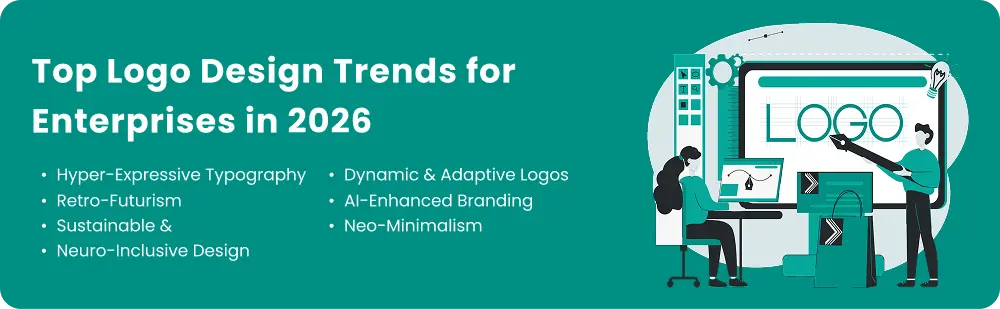
Top Logo Design Trends for Enterprises in 2026
- Dynamic & Adaptive Logos
Logos that morph across platforms, from app icons to marketing collateral, enabling responsive UI in SaaS, Retail, and eCommerce ecosystems. - AI-Enhanced Branding
Generative variations allow scalable personalization while maintaining identity integrity, ideal for EdTech, MarketingTech, and international platforms. - Neo-Minimalism
Soft gradients and reduced visual noise help users process information faster, perfect for Logistics, Analytics, and enterprise dashboards. - Hyper-Expressive Typography
Custom wordmarks convey personality and authority, especially in B2B, Media, and platform-driven companies. - Retro-Futurism
Balancing familiarity with modern design helps regulated or trust-sensitive sectors like Healthcare and Finance appear progressive yet approachable. - Sustainable & Neuro-Inclusive Design
High-contrast palettes and accessible shapes ensure usability for diverse audiences while reflecting environmentally conscious values.
A Strategic Logo Design Process
Professional logo design services typically follow four phases:
1. Discovery & Brand Audit
Analyze business goals, audience expectations, market positioning, and competitive landscape. Strategy drives design, not trends.
2. Concept Exploration & AI Iteration
Multiple directions are explored using both human insight and AI-assisted tools. This ensures adaptability, scalability, and differentiation.
3. Validation Across Real-World Scenarios
Logos are tested on dashboards, apps, marketing assets, and presentations to ensure performance in all touchpoints.
4. System & Guidelines Development
Deliverables include usage frameworks, adaptable guidelines, and governance to maintain brand consistency globally. This ensures teams across regions use the logo correctly, preserving identity integrity.
Enterprise Case Outcomes
Organizations adopting adaptive logo systems report:
- Improved brand recognition and recall
- Greater consistency across product ecosystems
- Enhanced first impressions in sales and partnerships
- Stronger internal team alignment and confidence
SaaS platforms, for example, achieve better interface cohesion, while HealthTech companies increase user trust and journey clarity with inclusive visual identities.
Frequently Asked Questions
1. What is included in professional logo design services?
Professional services go beyond a simple symbol. They include brand discovery, multiple design concepts, revisions, scalable formats (AI, SVG, PNG), and usage guidelines. Unlike generic logo generators, these services are tailored to your business strategy.
2. How many logo concepts will I typically receive?
Reputable services provide multiple distinct concepts, usually 2–6, to explore different directions. This helps stakeholders make informed decisions without overwhelming choices.
3. How do I prepare before hiring a logo designer?
Understand your brand purpose, audience, and long-term vision. Prepare answers to questions like: “Who is the audience?” and “What problems should the logo solve?” This shapes a focused brief.
4. How long does a logo design project take?
Timelines depend on discovery, iterations, and stakeholder feedback. Structured phases—research, prototyping, validation, ensure logos perform across real-world applications without rushed decisions.
5. Can a logo alone build a brand?
No. A logo is a visual anchor, not a brand by itself. Comprehensive branding also includes messaging, positioning, and user experience. A logo reinforces these elements but cannot replace a complete brand strategy.
Conclusion
A logo is no longer just a mark; it's a strategic interface connecting your business with a global audience. Enterprises today need logo design services that deliver clarity, trust, and adaptability across platforms, devices, and cultures.
Invest in logo design services that evolve with your enterprise and position your brand for long-term success.
Summary
- Logos in 2026 are adaptive brand systems rather than static symbols, designed to work across digital and physical touchpoints.
- Modern logo design services focus on scalability, accessibility, and global usability, not just aesthetics.
- Enterprises in SaaS, HealthTech, FinTech, and Retail are updating logos to maintain consistency and trust across products and markets.
- Key trends include dynamic/adaptive logos, AI-assisted variations, neo-minimalism, hyper-expressive typography, retro-futurism, and neuro-inclusive design.
- A structured design process—discovery, concept exploration, validation, and system development—ensures logos perform effectively in real-world scenarios.
- Logos alone don't build a brand; they reinforce strategy, messaging, and user experience for enterprise recognition.
- Investing in professional logo design services creates memorable, flexible, and universally effective visual identities for long-term brand growth.

