
Over 70% of users abandon apps or websites that feel confusing or unintuitive.
Every interaction you have with a website or mobile app is becoming smarter, faster, and more responsive. Artificial Intelligence is driving this transformation, shifting experiences from static interfaces to systems that adapt to your behavior, preferences, and context in real time.
This change goes beyond aesthetics. AI-powered UI/UX design focuses on anticipation, creating experiences that respond intelligently to user intent while reducing friction across every interaction. By combining foundational UI/UX principles with AI-driven intelligence, teams can build products that not only look polished but evolve continuously as user needs change.
This sets the stage for understanding why AI matters in UI/UX design today and how it's shaping digital experiences in 2026.
Why AI Matters in UI/UX Design
AI enhances UI/UX design by enabling interfaces to adapt dynamically based on user behavior, data patterns, and context. Traditional design follows fixed rules and predefined flows, which can make experiences feel rigid. AI replaces that rigidity with systems that learn and optimize continuously.
The goal is straightforward: create seamless, intuitive interactions while reducing user effort.
Common AI-driven applications include:
- Behavior-Based Personalization: Interfaces adjust to how users browse, scroll, search, and interact.
- Context Awareness: Layouts and themes respond to time of day, device conditions, or environmental cues.
- Predictive Navigation: AI anticipates the user's next action and streamlines their journey.
By shifting from static to adaptive design, experiences become more fluid, responsive, and aligned with individual needs.
What Is UI/UX Design?
UI/UX design defines how people interact with digital products, balancing usability, functionality, and visual clarity.
- UI Design (User Interface): The visual layer—colors, typography, layouts, icons, and interactive elements that define how a product looks.
- UX Design (User Experience): The functional layer—navigation, accessibility, responsiveness, and how smoothly users achieve their goals.
Together, User Interface design and UX design ensure digital experiences feel intuitive, efficient, and purposeful while solving real user problems.
Real-World Applications of AI in UI/UX Design
AI is already delivering measurable results across industries:
- E-commerce Platforms: Personalized recommendations and adaptive layouts increase product discovery and boost conversion rates.
- Healthcare Applications: Intelligent dashboards and smart reminders improve patient adherence and streamline workflows.
- Learning Platforms: Micro-personalized content sequencing enhances retention by adapting to individual learning behavior.
These examples show how AI-led UI/UX improvements translate into tangible business and user value.
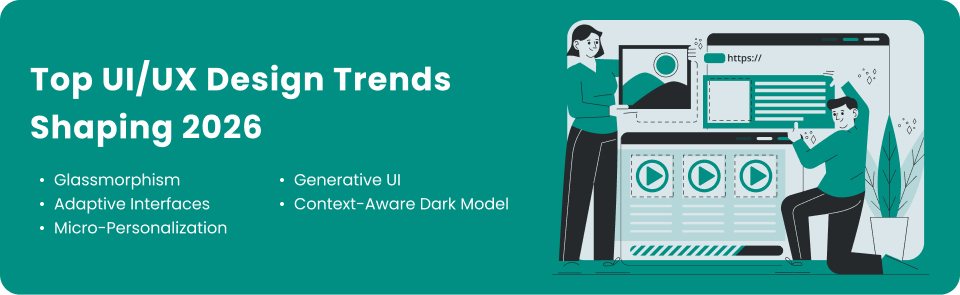
Top UI/UX Design Trends Shaping 2026
AI is redefining modern design systems by making them responsive, predictive, and context-aware. Key trends include:
- Glassmorphism: Frosted, transparent layers create depth while maintaining clarity and accessibility.
- Adaptive Interfaces: Layouts respond dynamically to user behavior, environment, and usage patterns.
- Micro-Personalization: Subtle adjustments in copy, visuals, and interactions for each user improve engagement without overwhelming them.
- Generative UI: AI suggests layout variations, speeding iteration while maintaining creative control.
- Context-Aware Dark Mode: Interfaces adjust automatically to lighting and user preferences.
These trends illustrate a move toward systems that listen, learn, and respond intelligently.
Benefits of AI-Powered User Experience Design
AI-driven UI/UX design offers more than visual improvements, delivering measurable business and user benefits:
- Personalization at Scale: Each user experiences interfaces tailored to their journey.
- Faster Design Iterations: AI identifies usability patterns and predicts friction points, reducing guesswork.
- Improved Engagement: Adaptive experiences keep users active and reduce drop-offs.
- Accessibility Enhancements: Context-aware adjustments make interfaces more inclusive.
Integrating AI into UI/UX workflows ensures experiences evolve alongside user expectations.
Challenges of Using AI in UI/UX Design
AI also introduces challenges that teams must navigate:
- Over-Reliance on Automation: AI-generated layouts may miss emotional nuance.
- Bias in Training Data: Skewed datasets can create unintentional exclusions.
- Loss of Creative Depth: Efficiency may come at the cost of storytelling or cultural sensitivity.
- Implementation Complexity: Integrating AI requires robust data pipelines and technical maturity.
- Privacy and Ethics: Context-aware personalization depends on user data, requiring transparency and consent.
AI works best when paired with human judgment, enhancing thoughtful design rather than replacing it.
How AI Is Changing UI/UX Decision-Making
AI is shifting design from static assumptions to continuous optimization. Teams can now test, learn, and adapt interfaces in real time, improving usability and reducing long-term design risk.
Successful AI-led UI/UX depends less on the tools themselves and more on how intelligence is applied within real product constraints.
Frequently Asked Questions (FAQs)
1. How does AI improve UI/UX design?
AI personalizes interfaces, adapts layouts in real time, and predicts user behavior, allowing experiences to evolve continuously.
2. What are the key AI-driven UI/UX design trends in 2026?
Adaptive interfaces, micro-personalization, generative UI, and context-aware dark mode are shaping more intuitive, user-centric experiences.
3. Can AI replace human creativity in design?
No. AI supports efficiency and insight, while human creativity drives emotion, storytelling, and cultural relevance.
4. How do businesses benefit from AI-powered UI/UX design?
Companies achieve higher engagement, stronger retention, and improved ROI through personalization and predictive insights.
Conclusion
AI is transforming UI/UX design, making digital products smarter, faster, and more responsive. It enables real-time personalization, streamlines workflows, and enhances usability—while human oversight ensures creativity, ethics, and privacy remain central.
Thoughtful implementation with UI UX design services provider like Oodles Studio will determine which products truly feel intuitive, scalable, and user-focused in 2026 and beyond.
Summary
AI is no longer futuristic, it is actively shaping how users interact with digital platforms.
Key takeaways:
- AI enables personalization at scale through adaptive interfaces.
- Predictive intelligence enhances navigation and engagement.
- Trends like glassmorphism, generative UI, and adaptive interfaces define modern UI/UX.
- Real-world applications show measurable gains in usability, retention, and satisfaction.

